

Rating Updated: TOP-40 Women in Leadership
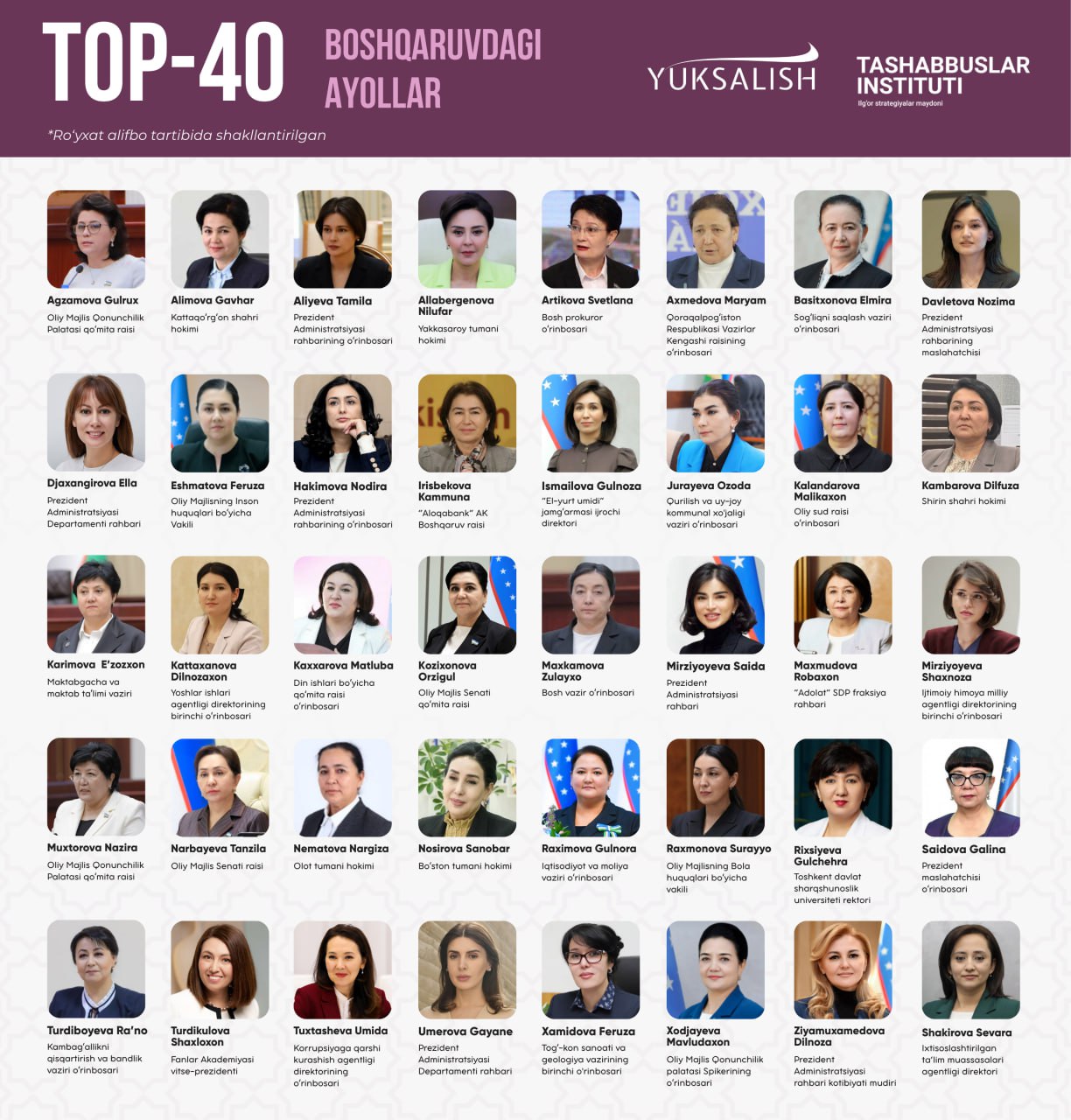
The “Yuksalish” Movement, in cooperation with experts from the Institute for Social and Economic Initiatives, has announced the TOP-40 Women in Leadership ranking among women actively working in the system of public and social governance.
It should be noted that the “Yuksalish” Movement annually publishes a ranking of women leaders in public administration on the occasion of March 8 – International Women’s Day. Previous rankings were compiled in 2020, 2021, 2022, 2023, 2024, and 2025 (link: https://t.me/uzbyuksalish/5228). In addition, in 2023, with the participation of regional experts, the first ranking of leading women in Central Asia was compiled.
In recent years, expanding women’s participation in public administration has become one of the priority areas of state policy in Uzbekistan. Special programs aimed at preparing women for leadership positions have been introduced, and indicators to ensure gender balance in the civil service are being established. At the same time, systematic measures are being implemented to increase the share of women in the кадровый reserve. Issues related to the protection of women’s rights, prevention of discrimination, and ensuring equal opportunities in appointments to leadership positions are being strengthened at the legislative level.
In this process, the formation of mechanisms for public oversight, transparency, and recognition plays an important role. Accordingly, the annual ranking of women in leadership published by the “Yuksalish” Movement is gradually becoming an effective public initiative aimed at promoting gender equality in the country.
The women included in the ranking represent various levels of state and public administration. Among them are leaders working in the Presidential Administration, the chambers of the Oliy Majlis, the Cabinet of Ministers, ministries and government agencies, local authorities, the financial and banking sector, education, as well as the judicial and legal system.
Analysis shows that many women included in these rankings have been appointed to higher positions in public administration in recent years, while some have advanced from regional leadership roles to positions at the national level. In addition, a number of nominees actively participate in decision-making processes at the level of sectoral leadership, committees, or agencies.
Rating Methodology
The ranking of women in leadership is compiled based on a multi-dimensional evaluation model. This model provides a comprehensive assessment of candidates not only by their official position, but also by considering their actual management performance, institutional influence, and level of public trust.
The ranking is formed based on the following key criteria:
• the influence of the position and scope of authority on decision-making processes;
• real results achieved in management and performance indicators;
• the level of participation in strategic reforms;
• the scale of territorial or sectoral impact;
• public trust and professional reputation.
Candidates’ activities are evaluated on a 100-point system, where each criterion has a weighted coefficient forming the final integrated score. During the assessment process, state statistics, open sources, sectoral reports, expert opinions, and media monitoring results are taken into account.
Such rankings play an important role in overcoming existing stereotypes in society, strengthening the role of women in leadership, and shaping a new generation of women leaders
Press Service of the “Yuksalish” Movement