
Yuksalish Movement in 2025: At the Center of Strategic Reforms and Social Transformation
The year 2025 was marked in the history of Uzbekistan’s civil society as a milestone, signifying the Yuksalish Movement’s transition to a new stage of development. It not only remained an active participant in domestic processes, but also emerged on the international stage as a Movement that consistently represents and advances the interests of Uzbekistan.
International Engagement
Within the framework of more than ten international visits (including Türkiye, the European Union, the Republic of Korea, and others), the Yuksalish Movement has actively promoted Uzbekistan’s reform agenda while facilitating the development of new partnerships. In parallel, it continued its efforts to strengthen local governance, including support for establishing international cooperation by regional and municipal authorities. Notably, Sister City partnerships were formalized between Samarkand and Konya, as well as Navoi and Zeytinburnu. During the visit to Türkiye, investment agreements worth USD 129 million were signed across 15 projects.
The Yuksalish Movement has identified the promotion of regional solidarity and people-to-people diplomacy in Central Asia as a strategic priority. In 2025, close cooperation with experts of the Central Asia Civil Society Forum continued. As part of this collaboration, research initiatives were launched for the first time to assess the contribution of civil society institutions to national development across the region.
Furthermore, through more than ten foreign visits, new partnerships were established in countries including the United States, France, Belgium, Italy, the Republic of Korea, and Azerbaijan.
Public Monitoring: From Utility Services to Housing Development
In 2025, public oversight of government activities was significantly strengthened. Particularly, the implementation of the “Uzbekistan 2030” Strategy at the local level became a focal point for the Movement’s efforts.
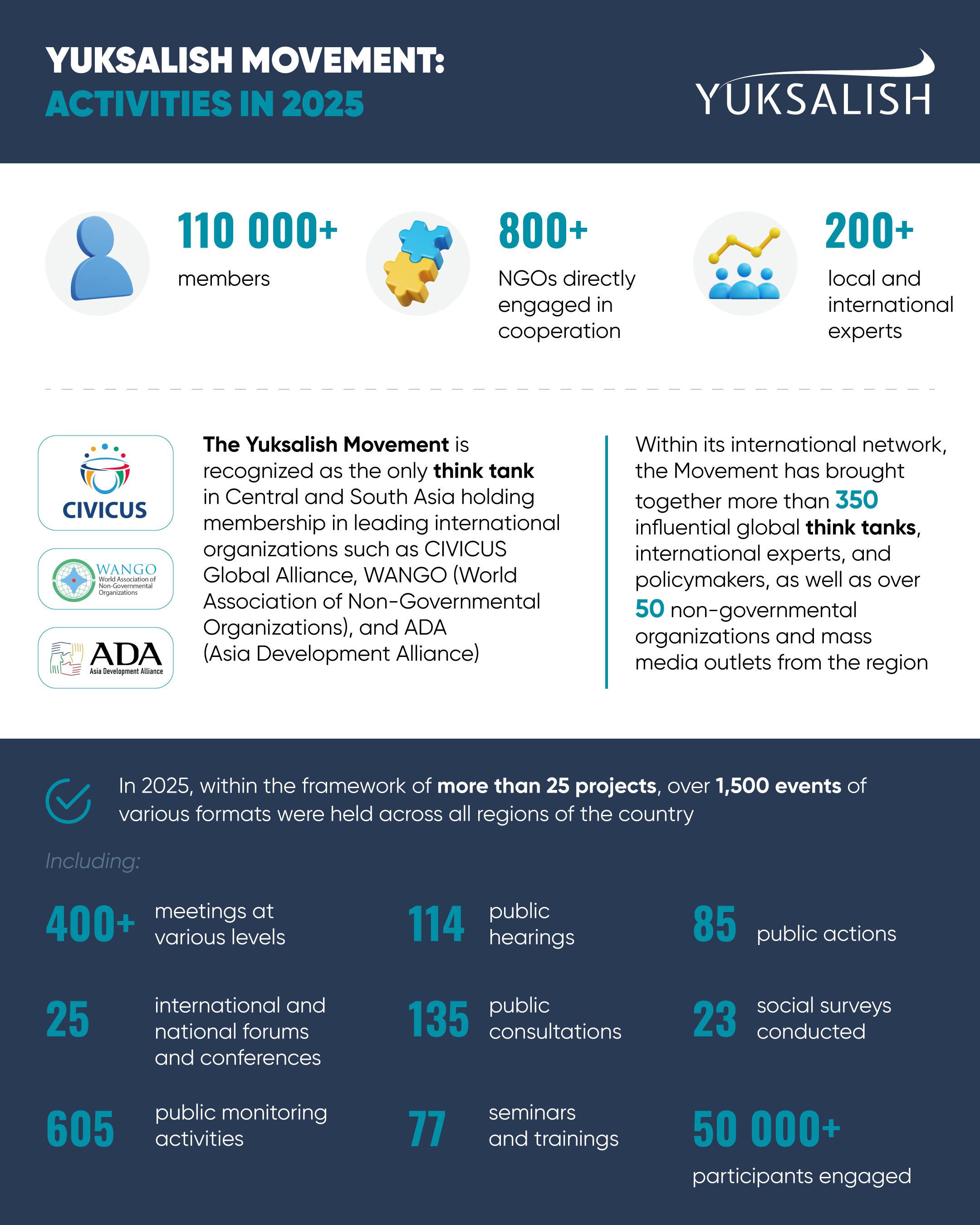
The number of public monitoring activities reached 605. Most importantly, these monitoring efforts were not conducted merely for reporting purposes but were aimed at addressing specific, tangible issues.
As a result, 28 analytical reports, with recommendations and suggestions, were submitted to the Presidential Administration, the chambers of the Oliy Majlis, and the Cabinet of Ministers. At the local level, more than 450 analytical materials were submitted for implementation.
The local council deputies introduced these issues, with the number of positively resolved matters increasing twofold in the regions (by 50) and by 33 in districts compared to the previous year.
Surveys on simplifying weddings, public oversight of drinking water supply projects, and proposals regarding reducing customs duties on consumer goods imported by citizens from abroad generated significant public interest, leading to greater citizen involvement in national processes.
Additionally, public monitoring activities were supported by active participation in overseeing shortcomings in municipal services provided by management-service companies and construction defects in the New Uzbekistan residential areas.
Assistance in Lawmaking
The Yuksalish Movement established strong cooperation with both chambers of the Oliy Majlis. In partnership with Parliament, and with the involvement of the leadership of relevant ministries and agencies, 9 public hearings were organized on urgent issues.
Additionally, more than 20 legislative draft proposals were reviewed, and 5 normative documents were subjected to public expert examination. The contributions of the Movement's experts were successfully integrated into these drafts. Specifically, provisions imposing additional obligations on public catering establishments were removed from the drafts, and a number of additional proposals aimed at reducing traffic congestion in Tashkent were incorporated.
Human Capital and Social Projects
The core principle of the Yuksalish Movement’s activities is based on the “human dignity” ideology, which is practically reflected in the following initiatives:
• “Hayot Ulashtirish” (Life Sharing): As a result of water extraction from a depth of 200 meters in Surkhandarya, clean drinking water reached nearly 2,500 households. In Samarkand, over 2 billion UZS were raised to provide drinking water to over 2,000 people, with construction work already underway.
• “Legal Consultation Day”: 256 professional lawyers and notaries were engaged nationwide to provide free legal assistance to over 6,000 citizens in need.
• Within the scope of the “One Million Trees” campaign, green areas were expanded from Muynak to Tashkent.
Digital Media and Communication Strategy
In 2025, the Yuksalish Movement operated effectively within the information space. The total reach exceeded 100 million, with over 1,400 posts, 105 videos, 94 infographics, and more than 370 print articles delivering crucial information to the public.
Supporting Civil Society
Supporting civil society remained a key priority for the Yuksalish Movement in 2025. The primary focus was on enhancing the capacity of representatives from newly established non-governmental organizations (NGOs), young activists, journalists, and environmentalists. Through 45 training sessions and 32 seminars, over 300 participants were provided with skill-building opportunities.
The Movement placed special emphasis on the effective operation of public councils in Uzbekistan. In this regard, the activities of public councils formed under ministries, agencies, and local executive bodies were analyzed, and their rankings were published.
As part of the year-end summary, over 100 activists gathered during the week-long event, where 20 strategic proposals were developed. The “Heroes Among Us” awards ceremony, traditionally held, honored 30 selfless individuals, contributing to the promotion of a culture of activism within society.
The activities of the Yuksalish Movement in 2025 demonstrate that the organization has evolved from a standard NGO to a strategic platform for dialogue between the state and society. With over 110,000 members, the Movement aims to remain a key driver in the country’s democratic renewal processes in 2026.