

Supporting the Sustainable Development of Civil Society in Central Asia
Speaking about the reforms in post-Soviet countries during the 1990s, Margaret Thatcher once remarked: "We don’t need society, because individual men and women, and the private sector, will do everything we need."
We have experienced firsthand the profound impact that the course of market reforms has had on our societies. Many of the familiar mechanisms and institutions that once supported social development were either sidelined or deemed harmful. In Kazakhstan, for instance, reform efforts led to significant social stratification and, subsequently, the atomization of society.
This raises a critical question: is it possible to build a civil society when the very fabric of society around it is unraveling?
(Charles Buxton, Civil Society in Central Asia: Overcoming the Crises of Post-Soviet Development, 2017)
Despite claims that civil society in the newly independent states of Central Asia is a “new” phenomenon that only began to emerge after 1991, it is important not to overlook the Soviet period. Many NGO leaders gained valuable experience—professional, civic, and otherwise—during the preceding era, through their involvement in party, Komsomol, trade union, and other organizational structures.
Moreover, beyond the Communist Party and its affiliates, the Soviet period also featured other mass public organizations that contributed to political socialization. These included trade unions across various sectors, DOSAAF (the Voluntary Society for Cooperation with the Army, Aviation, and Fleet), friendship societies, and a variety of professional and cultural associations. In this sense, there was a widespread culture of civic participation, and it would be inaccurate to suggest that civil engagement in contemporary Central Asia emerged from a vacuum.
At the same time, it is essential to recognize that many pre-Soviet institutions and traditions remained largely intact throughout the Soviet period. These traditional structures can be viewed as the foundational roots of modern civil society. A particularly noteworthy example is the Uzbek mahalla system. As outlined in an official document, there is an explicit goal to transform the mahalla—a unique social institution—into a true ally and advocate for the population, enhancing its role and significance, bringing it closer to the people, and ensuring a healthy and stable socio-spiritual environment within society and the family.
Today, each country in Central Asia has developed its own unique set of civil society institutions. This includes both traditional, or rather classical, structures—such as non-governmental/non-state public organizations, professional unions, and various associations—as well as context-specific forms, like the aforementioned mahalla or other localized self-organization mechanisms. In Kazakhstan, for example, the search for an effective model of local self-governance has led to the pilot introduction of kenes councils.
Naturally, the development of civil society structures does not always proceed smoothly. Quantitative growth does not always translate into qualitative progress.
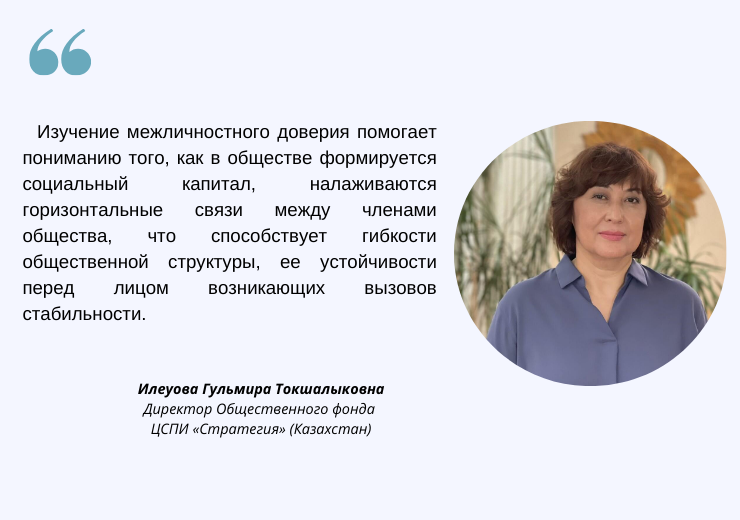
This raises a fundamental question: from the perspective of the state, what does the sustainable development of civil society actually mean? To answer this, the concept of trust becomes essential. In our sociological research, we distinguish between two types of trust: interpersonal (between individuals) and institutional (trust in state institutions). Institutional trust is a multi-dimensional concept, typically measured through large-scale public surveys aimed at assessing and approving the performance of key government bodies. Studying interpersonal trust, on the other hand, helps us understand how social capital is built within society and how horizontal connections among citizens are formed—factors that contribute to the resilience and adaptability of the social structure in the face of stability challenges.
This is precisely why all states have a growing need for functioning and resilient civil society institutions. In Kazakhstan, for instance, the media has consistently remained a leading institution in terms of public trust over many years. According to a 2023 study, 43% of respondents expressed trust in traditional media outlets, while trust in bloggers is also on the rise, with 38% of citizens indicating confidence in their content.